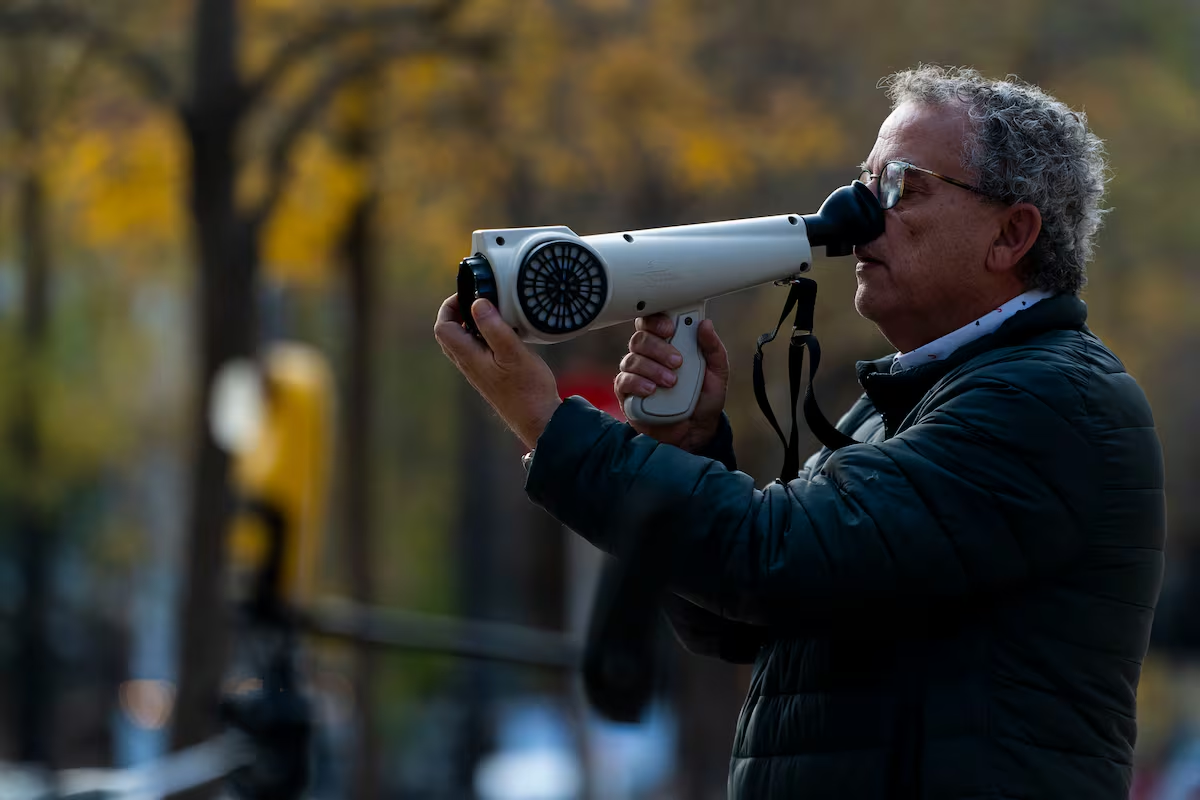
The conversation about air quality in Spain has taken an unexpected and refreshingly human turn. Instead of focusing solely on regulatory limits and mathematical dispersion models, Spain is increasingly asking a simpler question: What does the air actually smell like where people live?
A recent El País article exploring the challenges of odor measurement highlights this shift — and brings attention to St. Croix Sensory’s Nasal Ranger® Field Olfactometer.
Why Odor Is So Hard to Measure
Odor pollution — whether from industrial operations, agriculture, or wastewater treatment plants — remains one of the most difficult environmental issues to quantify. In Spain, as at St. Croix Sensory, traditional odor analysis follows European Standard EN 13725, in which air samples are collected and sent to specialized laboratories for dynamic olfactometry.
This method is exceptionally useful for understanding emission strength at the source. But it tells us far less about something equally important: how odors are actually experienced by people in nearby communities.
Where Field Measurements Fill the Gap
That’s where field olfactometry tools like the Nasal Ranger come in.
In the El País article, environmental inspector — and St. Croix Sensory distributor — José Cid discusses Spain’s growing momentum toward formal odor regulation. Mr. Cid uses the Nasal Ranger, paired with current weather conditions at the sampling location, to assess worst‑case odor scenarios in real time.
This approach does more than simply note whether a smell is present. It quantifies odor intensity at different dilution levels, producing a measurement that aligns far more closely with residents’ lived experience. As Spain confronts increasing odor-related complaints, the Nasal Ranger is becoming an indispensable bridge between laboratory science and community impact.
A Broader Shift in Environmental Monitoring
Spain’s adoption of the Nasal Ranger reflects a larger tension in air-quality monitoring: scientific rigor vs. real‑world relevance.
Laboratory methods remain essential for regulatory compliance and permitting. But field measurement acknowledges something just as crucial: odors matter most where people breathe them — in homes, on streets, and in public spaces.
Field olfactometry isn’t replacing laboratory testing; it’s complementing it, filling in the missing piece about actual environmental impact.
A Modern Response to an Age‑Old Nuisance
From regulators to scientists to everyday citizens, Spain is grappling with how to measure, manage, and ultimately mitigate odors in a way that reflects both scientific standards and human experience. Tools like the Nasal Ranger are becoming part of that conversation — offering a practical, defensible method of understanding odors as people truly encounter them.